Know More
For Those Who Are Aware
Issue 2: The U.S. Now Pays More in Interest Than on Defense
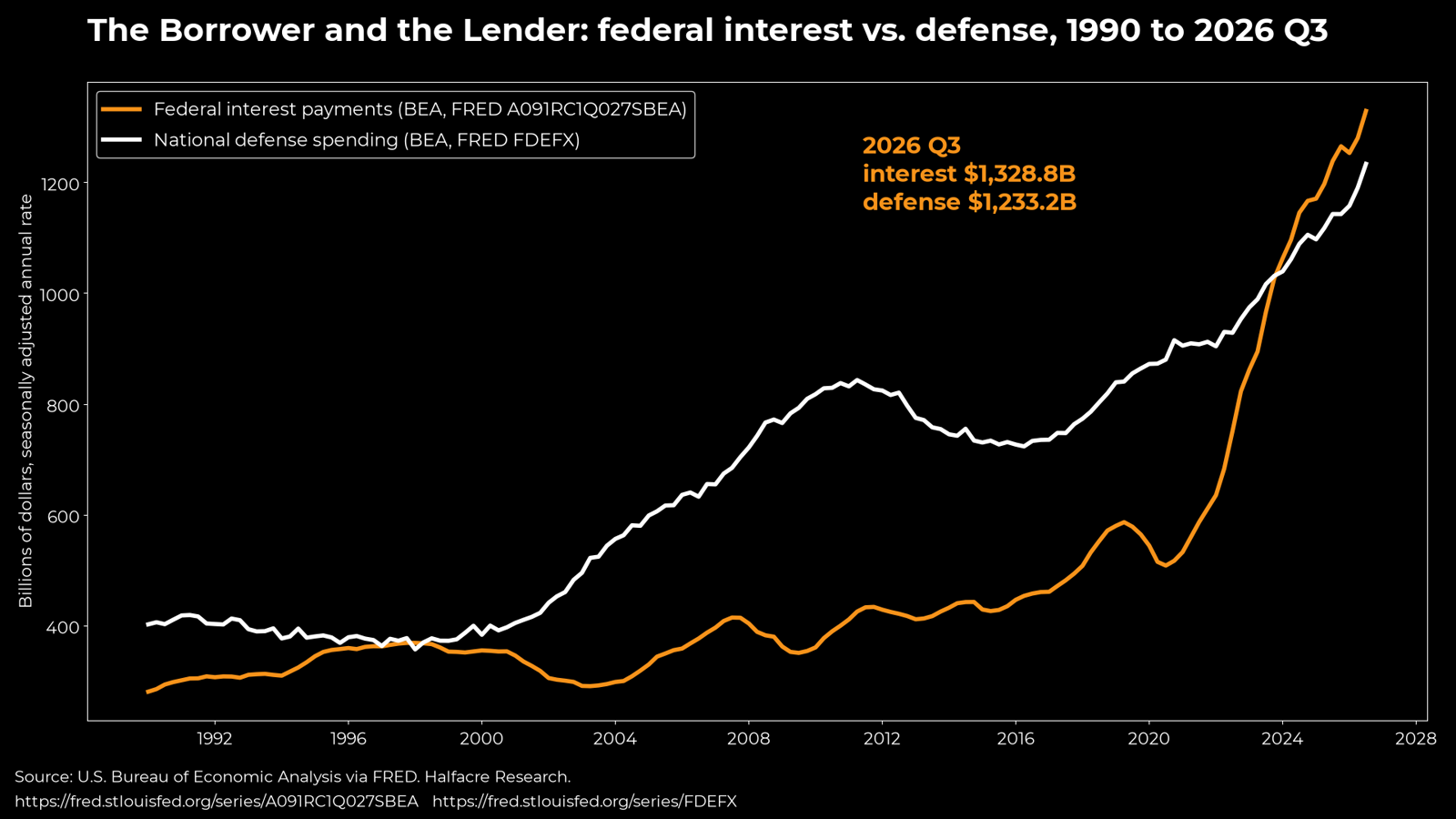
This week's chart: federal interest payments vs. national defense spending, 1990 to 2026 Q3. Sources: U.S. Bureau of Economic Analysis via FRED, federal interest payments (https://fred.stlouisfed.org/series/A091RC1Q027SBEA) and national defense consumption and investment (https://fred.stlouisfed.org/series/FDEFX).
The house on the hill
Picture a village where one man owns the largest house on the hill. Each year he pays a few guards to walk his fence at night, and each year he borrows a little from the lender at the bottom of the road to cover what his harvest does not. The loans are easy to take. The payments are small at first, smaller than the wages of a single guard.
Seasons pass. The borrowing never stops, and the payments grow quietly beside it. One winter the borrower counts his coins and finds something strange. He now sends more silver down the road to the lender than he spends guarding his own house.
The fence is still walked. The house still stands. Even so, the largest steady payment leaving that house no longer protects it. It goes to the person who holds the paper.
In a village that runs on debt, the quiet one with the ledger is the one who gets paid first.
The lender, meanwhile, does nothing dramatic. He keeps his ledger, collects on schedule, and lends again.
Get Know More by email
One chart and one story about your money, sent to your inbox.
Meet your AI partnerThe crossing in the federal record
The federal record now shows the same crossing.
- 2026 Q2: federal interest payments ran at $1,279.7 billion a year, while national defense spending ran at $1,189.9 billion, both seasonally adjusted annual rates from the Bureau of Economic Analysis.
- 2026 Q3: the gap widened, with $1,328.8 billion in interest against $1,233.2 billion for defense.
- 2024 Q1: interest first passed defense in this data, at $1,062.8 billion against $1,039.1 billion, and has stayed above it every quarter since.
- Before that, the last time interest topped defense was a single quarter in 1998.
- As recently as early 2010, interest was $360.3 billion and defense was $817.5 billion.
Sources: https://fred.stlouisfed.org/series/A091RC1Q027SBEA and https://fred.stlouisfed.org/series/FDEFX. Recent quarters are early estimates and may be revised.
Where the interest goes
Every dollar of that interest lands somewhere. It goes to whoever holds the government's bonds: pension funds, insurers, foreign governments, the central bank, mutual funds, and individual savers holding Treasury securities directly.
A country that borrows becomes, by arithmetic, a country with a growing class of people and institutions it must keep paying, year after year.
Which side of the ledger are you on?
That is the lesson worth seeing clearly. Debt is never only a burden. On the other side of every borrower stands a lender, and the payment that weighs on one side is income on the other.
On the other side of every borrower stands a lender.
For a saver, the useful question is not whether the borrower is right or wrong. It is which side of the ledger your own money sits on, who is paying you, who you are paying, and how much of your own budget already flows down the road in interest.
For the comments: In your own household, does more go down the road to lenders, or come back up it?
Talk it through with Matthew
Book a free Google Meet with Matthew Halfacre.
Book a free Google Meet with Matthew Halfacre
Meet your AI partner free at halfacreresearch.tech.
Know more. Bank less.
Research and education only. Not investment, tax or legal advice, and not personalized to you. You decide. Halfacre Research.
Halfacre Research is not registered as an investment adviser with the SEC or any state, and no adviser-client relationship is created by reading this or booking a call.
Get the next issue
One chart and one story about your money, sent to your inbox.
Meet your AI partner