Know More
For Those Who Are Aware
Issue 1: What a 1913 Dollar Buys Today
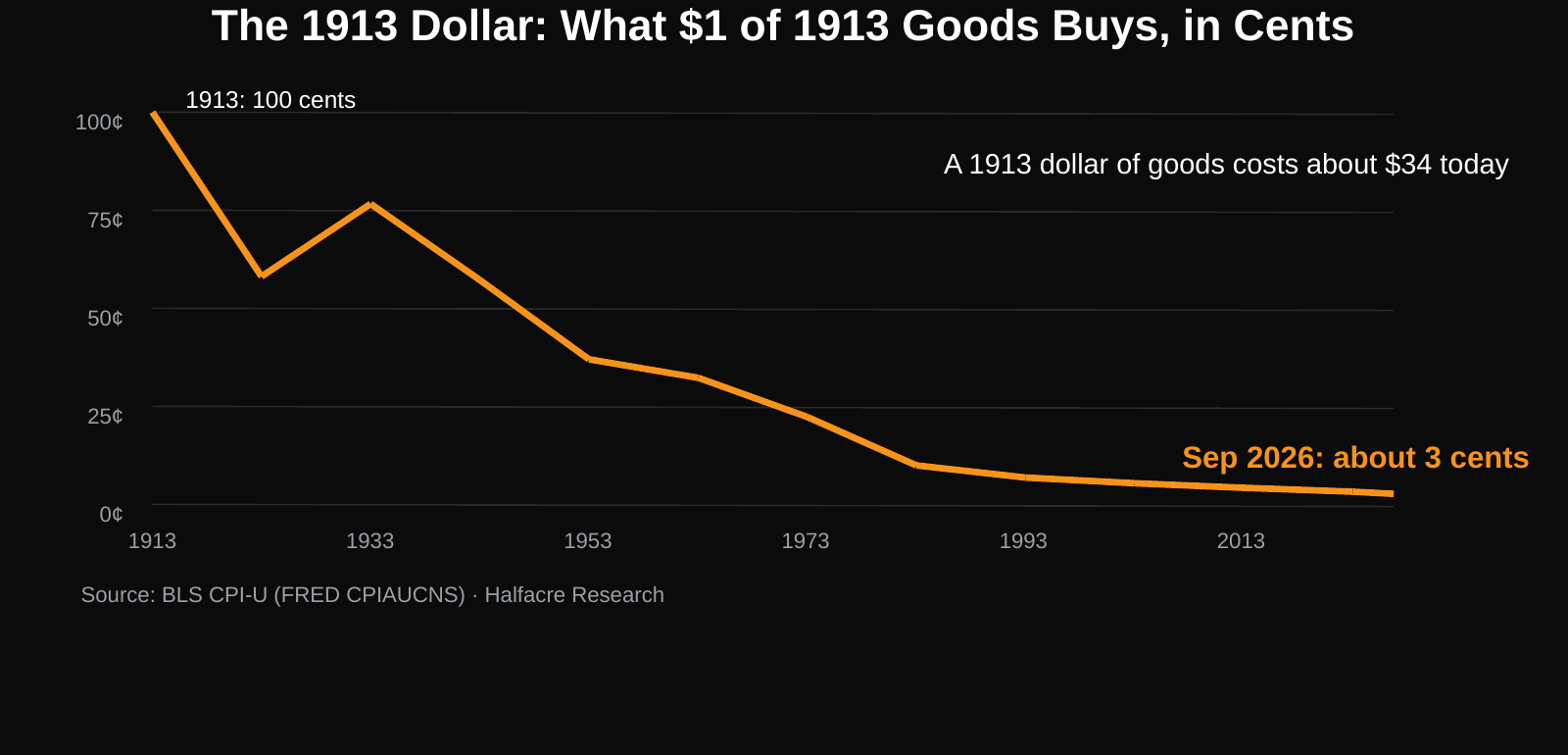
This week's chart: the Consumer Price Index (CPI-U), 1913 vs. September 2026. Source: U.S. Bureau of Labor Statistics.
A farmer once carried his grain to market in an old sack. Every season he filled it to the brim, slung it over his shoulder, and walked the long dirt road into town. Every season, when the buyer set the sack on the scale, it weighed less than he had packed. He blamed the scale. He blamed the buyers. He blamed the dry wind off the fields. He worked longer, packed tighter, and walked faster. Still, he arrived short.
One morning his daughter walked a few steps behind him. Halfway to town, she stopped him and pointed back down the road. A thin golden line of grain stretched through the dust all the way back to the farm. At the bottom of the sack was a small tear. It was too small to see from the top and too slow to feel on his shoulder, but over enough miles it was wide enough to spill a lifetime of harvests onto the road. The farmer never needed to work harder. He needed to see the tear.
Get Know More by email
One chart and one story about your money, sent to your inbox.
Start talking to the AI freeThe dollar has a tear of its own, and the official record shows how wide it has grown. In 1913, the year Congress created the Federal Reserve, the Consumer Price Index stood at 9.9. In September 2026, it stood at 336.94. That is the Bureau of Labor Statistics' own measure of what everyday goods cost. The math is simple: a 1913 dollar now buys about 3 cents' worth of what it once did. Put another way, it takes about $34 today to buy what $1 bought then.
Like the farmer's grain, the loss never came all at once. No single year emptied the sack. It leaked a little at a time, mile after mile, and that is exactly why no one noticed. A sudden loss demands an answer. A slow one is easy to blame on the scale, the buyers, or the weather, while the real cause trails quietly behind you.
That is the trap of measuring progress only in dollars. The balance on your statement is the weight you packed at the start of the road. What matters is the weight that reaches the scale: what that money can actually buy when you need it. A number can grow every year while the grain keeps leaking out. For families building savings and institutions managing reserves alike, the real question isn't how full the sack looks at the start. It's how much will be left at the end of the road, and whether the sack itself is sound.
For most of the last century, only institutions and the wealthy had the research teams and the time to study that question seriously. Everyone else got a statement and was told a rising number meant progress. AI changes that. Now anyone can have a research partner that walks behind the sack, spots where the grain is slipping, and explains the options in plain language, while every decision stays with the person who owns the harvest.
For the comments: If you walked a few steps behind your own savings, where would you find the tear?
Meet your AI partner free at halfacreresearch.tech.
Know more. Bank less.
Get the next issue
One chart and one story about your money, sent to your inbox.
Start talking to the AI free